
Paris Fashion Week 2026: the definitive guide
25 August 2026
Paris Fashion Week 2026: The Ultimate Guide
Every year, Paris returns for a single week to become the nerve centre of global fashion. Shows in legendary venues, private parties, hushed private-mansion salons and tables reserved months in advance form a complete ecosystem where creators, buyers, journalists and fashion lovers from around the world meet. For the 2026 edition, the Spring-Summer 2027 ready-to-wear runs from 5 September 2026, according to the provisional calendar published by the Fédération de la Haute Couture et de la Mode. This guide gathers, in a single document, everything you need to know to understand, follow and, as far as possible, experience this event from the inside.
Paris Fashion Week 2026: Dates and Essential Information
Paris Fashion Week is not an isolated event but a succession of dates spread across the year, each dedicated to a category of collections. For 2026, subject to confirmation by the FHCM, Autumn-Winter 2026-2027 menswear takes place from 20 to 25 January, Spring-Summer 2026 haute couture from 26 to 29 January, Autumn-Winter 2026-2027 womenswear from 2 to 10 March, Spring-Summer 2027 menswear from 23 to 28 June, Autumn-Winter 2026-2027 haute couture from 6 to 9 July, and the most media-followed womenswear Spring-Summer 2027 from 28 September to 6 October.
This latter edition is the one this guide focuses on. According to the provisional FHCM calendar, it brings together one hundred and one houses for sixty-eight shows and thirty-three official presentations over nine days. Julie Kegels is set to open the week on 28 September, with Louis Vuitton closing it on 6 October — details to be confirmed as the event approaches, with exact venues generally communicated only in the days preceding. One point that often surprises newcomers is that collections presented in September 2026 are for spring-summer 2027, with fashion always showing six months to a year before the season it clothes, allowing time for boutiques to place orders and production to follow.
What Is Paris Fashion Week?
Paris Fashion Week refers to all shows and presentations organised in Paris by couture and ready-to-wear houses under the aegis of the FHCM. It brings together major historic houses — Dior, Chanel, Saint Laurent, Louis Vuitton and Balenciaga — alongside emerging designers who use the Parisian showcase to make themselves known. The event is not limited to runways: it encompasses static presentations, showrooms, press appointments and a growing number of digital activations. Paris is part of the global fashion Big Four, alongside New York, London and Milan, and retains a special place as it hosts both ready-to-wear and haute couture, a virtually unique discipline governed by strict rules set by the FHCM itself.
Why Is Paris the Global Capital of Fashion?
Several factors explain this position, built over more than a century. First, its historical anchoring: Parisian haute couture, born in the nineteenth century, set the codes that the entire world subsequently adopted. Next, the density of houses present in a restricted area, with the majority of historic luxury headquarters located within a few kilometres of one another between the 1st, 8th and 16th arrondissements. Finally, the city's ability to combine architectural heritage and contemporary scenography, with shows taking place at the Grand Palais as well as the Palais de Tokyo or in private mansions, distinguishing Paris from other fashion capitals where shows are more concentrated in a single location. Added to this is a unique economic and artisanal fabric, where embroidery workshops, leather goods makers and feather artisans perpetuate a level of craftsmanship few cities can claim on this scale.
How Does Paris Fashion Week Work?
Concretely, each house on the official FHCM calendar has a time slot and, in theory, a venue often confirmed late. Guests — whether press, buyers, celebrities or partners — receive a nominative invitation specifying their seat. Alongside the shows, presentations take place as a more intimate format where pieces are shown without a runway staging, as well as showrooms where buyers can examine collections in detail before placing orders. A typical day for a fashion professional alternates between shows, showroom appointments, business lunches and networking breaks, often in the same iconic establishments around the Opera district or Saint-Honoré, which become informal rallying points for the duration of the week.
Key Houses and Designers of the 2026 Edition
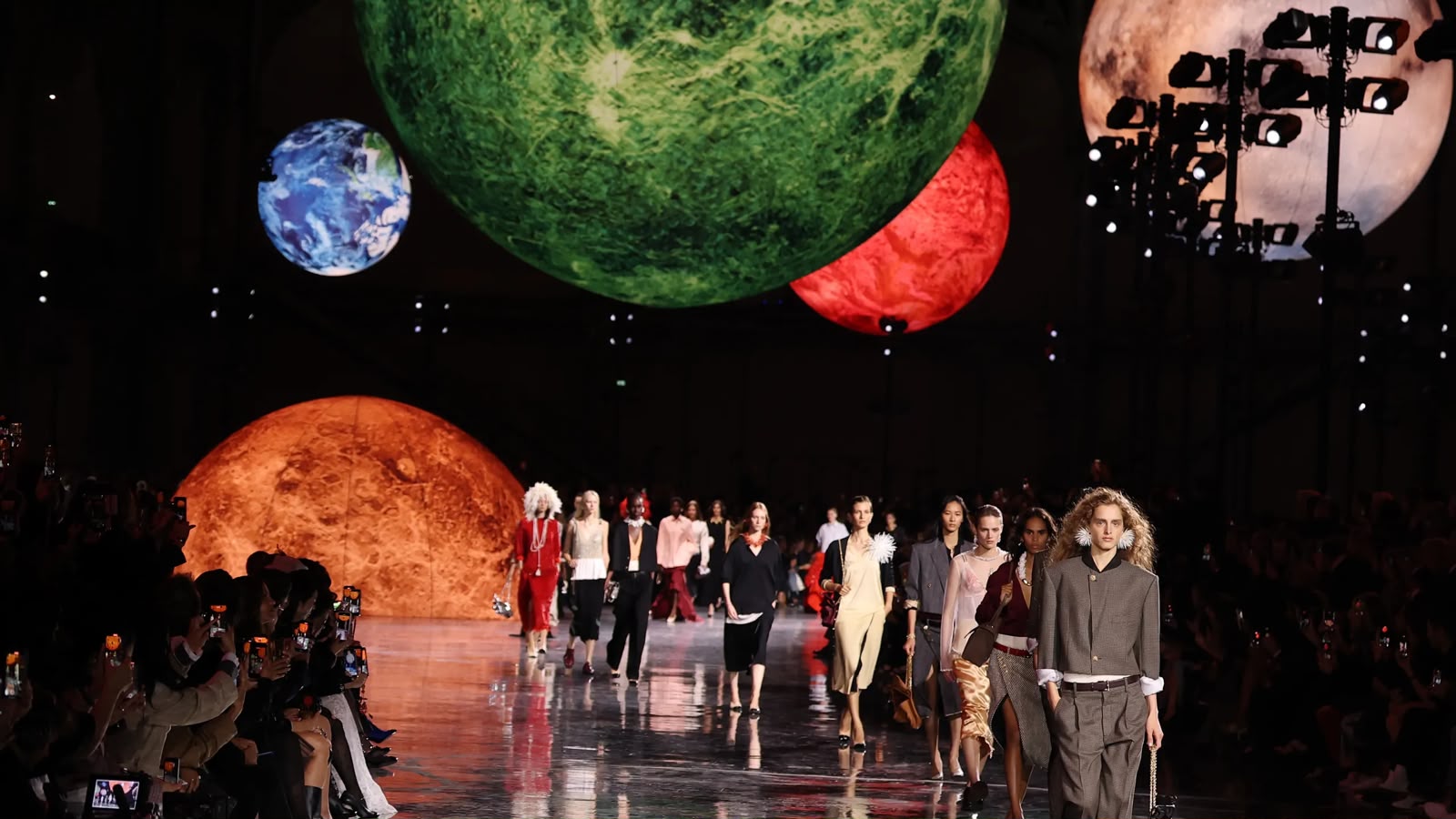
The September-October 2026 edition is marked by strong creative renewal, with several houses presenting the first collections of their new artistic directors — a moment always closely watched by the press and buyers, as each debut collection is perceived as a statement of intent for the house's future. The calendar features historic names such as Dior, Saint Laurent, Chanel, Louis Vuitton, Chloé, Lanvin, Balenciaga and Balmain, alongside houses with strong identities like Rabanne, Courrèges, Comme des Garçons and Iris Van Herpen, as well as emerging designers making their debut on the official calendar.
The Show Schedule
The detailed schedule, with times and venues, is published by the FHCM as the event approaches and remains subject to change. Beyond the shows themselves, the September-October 2026 edition includes the SPHERE showroom — the Federation's platform dedicated to young designers, hosted at the Palais de Tokyo from 30 September to 6 October 2026 — a notable appointment as it is accessible to a broader public than the shows themselves.
How to Access Paris Fashion Week 2026 Shows?
Access to Paris Fashion Week shows is exclusively by nominative invitation, issued by each house to its own audience of press, buyers, partners and celebrities; there is no ticketing open to the general public for the runways. Certain ancillary formats, such as the SPHERE showroom, are however accessible upon registration.
Unlike a concert or a classic trade fair, a fashion show is not an event accessed by purchasing a ticket. Each house compiles its own guest list, generally comprising journalists and fashion editors accredited by their media and the house press office, professional buyers representing department stores, multi-brand boutiques or retail platforms, influencers and content creators invited according to each house's communication strategy, privileged clients and partners invited directly, as well as celebrities and public figures associated with the brand image.
This organisation explains why accessing a show is generally not comparable to buying a public event ticket: every invitation results from a direct relationship between the house and the guest, or from a professional accreditation validated in advance. For someone outside these circles, securing a front row seat or even a standing place remains, by nature, uncertain and dependent on the goodwill and availability of each house. It is precisely in this context that specialised concierge platforms like MEMBRE® Society can deliver real value, not by promising access that does not depend on them, but by researching possibilities, reviewing each request on a case-by-case basis, and supporting the member through the process according to the availability and conditions specific to each event.
How to Get an Invitation to Fashion Week?
An invitation to a show is generally obtained through professional accreditation — whether press, buying or brand partnership — or through a direct relationship with the press office of the house concerned; there is no universal procedure guaranteeing an invitation.
For professionals, the most direct route is to contact the press or public relations office of the house several weeks before the event, justifying their status as a media outlet, store or influencer. For individuals outside these circles, options are more limited: certain parallel events, brand activations or parties organised on the margins of the official calendar offer more accessible formats than the shows themselves. It is also within this framework that a request may be reviewed by a specialised concierge, who will research existing options according to the member's profile and wishes, without ever being able to guarantee a favourable outcome.
Can You Attend Fashion Week Without Being a Professional?
Yes, to a limited extent: the shows themselves remain reserved for house guests, but certain formats, such as the SPHERE showroom at the Palais de Tokyo, are open upon registration, and numerous off-calendar events, brand activations or exhibitions take place on the margins of the official schedule and are accessible to a wider public.
Fashion Week's atmosphere extends far beyond show venues: animated window displays, pop-up stores, temporary exhibitions and street animations allow visitors to experience part of the excitement without holding a podium invitation. Following the official accounts of the houses and the FHCM remains the most reliable way to spot these public opportunities.
VIP Experiences During Fashion Week
Beyond show access, Fashion Week generates an entire ecosystem of high-end experiences, whether private dinners organised by houses, after-shows, exclusive collection presentations or personalised shopping appointments. These experiences, often reserved for a restricted circle, can, depending on cases and availability, be researched by a luxury concierge, who will coordinate multiple services such as dining, transport, accommodation and event access to build a coherent stay.
Events and Parties Around the Shows
Each edition of Fashion Week is accompanied by intense nightlife, spanning collection launches, house parties, press dinners and after-parties in partner clubs or hotels. These events, widely covered by the fashion press and social networks, often serve as the setting for the most striking encounters between industry professionals, celebrities and distinguished guests.
Where to Dine During Fashion Week?
Certain Parisian addresses become, for the duration of a week, essential meeting points for fashion professionals, whether restaurants in the Opera district, starred tables near the Golden Triangle, or historic brasseries favoured for informal lunches between appointments. Reservation, particularly for the most sought-after tables, is generally made several weeks in advance given the exceptional crowds of the period.
Where to Stay in Paris?
Palaces and luxury hotels located near major show venues in the 8th, 1st or 16th arrondissements are fully booked months before the event, with rates significantly higher than the rest of the year. Booking accommodation several months in advance remains the best guarantee of securing a convenient location, particularly if the stay combines multiple days of shows and professional appointments.
Best Neighbourhoods During Fashion Week
Historically, the Golden Triangle — between Avenue Montaigne, Avenue George V and Rue François 1er — concentrates numerous luxury house headquarters and a portion of the shows. The Saint-Honoré district, nestled between boutiques and private mansions, remains a nerve centre for shopping and showrooms. The Marais, more creative and alternative, hosts a greater number of young houses and off-calendar events. Finally, the Palais de Tokyo and Trocadéro sector takes on particular importance with the hosting of the SPHERE showroom.
Fashion Week and Celebrities
The presence of front row celebrities is an integral part of the communication strategy of houses, associating their image with personalities from film, music or sports. This media visibility fuels a large part of the event's press coverage far beyond the circle of fashion professionals.
Fashion Week and Professional Networking
For industry professionals — buyers, journalists, consultants or brand creators — Fashion Week constitutes one of the densest networking appointments of the year. Lunches, cocktails and informal meetings organised alongside the shows often play a role as decisive as the shows themselves in building future partnerships.
How to Organise Your Fashion Week Stay?
A successful stay during Fashion Week is prepared upstream, spanning accommodation booking, anticipation of accreditation or invitation requests, scouting of restaurants and events of interest, and organisation of travel in a city where traffic densifies significantly during this period. The coordination of multiple services — hotel, restaurant, transport and events — can be entrusted to a specialised concierge capable of adjusting the schedule according to current availability.
How MEMBRE® Society Can Organise Your Fashion Week Experience in Paris
MEMBRE® Society is an international marketplace for services, experiences and premium access. Without ever presenting itself as the organiser of Fashion Week or as holding show invitations — which remain at the sole discretion of the houses — MEMBRE® Society can, depending on requests and availability, research access possibilities to certain Fashion Week-related events, review an invitation or participation request, identify available VIP experiences, organise bookings at sought-after restaurants, coordinate access to private parties, book hotels suited to the stay, arrange private transport, coordinate multiple services to build a coherent stay, and accompany the member throughout their stay via its AI concierge interface, Olivia. Every request is reviewed on a case-by-case basis, based on actual availability and conditions set by each event or establishment, without any guaranteed outcome in advance.